Compare the implemented local CLI against documented vendor capabilities. Frontguard’s model-assisted analysis and fix verification are optional, and its hosted surfaces remain pre-release.
Percy
hosted review workflow
Chromatic
Storybook-centered
BackstopJS
low recent activity
Lost Pixel
sunset
Comparison between Frontguard, Percy, Chromatic, BackstopJS, Lost Pixel, and Argos
CAPABILITY
Frontguard
Percy
Chromatic
BackstopJS
Lost Pixel
Argos
Open source
✓ MIT
✕
◐
✓
◐
✓ MIT
CLI-first
✓
✕
✕
✓
✓
✓
AI change classification
✓ optional
◐
✕
✕
✕
✕
AI fix verification
◐ experimental
✕
✕
✕
✕
✕
Multi-render consensus
◐ configurable
◐
◐
✕
✕
◐
Cross-OS render normalisation
◐ unvalidated
✓
✓
✕
✕
✕
Runs without a hosted service
✓
✕
✕
✓
◐
◐
Storybook integration
✓
✓
✓
✕
✓
✓
MCP server for in-IDE agents
◐ pre-release
✕
◐
✕
✕
✕
PR comment with thumbnail triplet
◐ source only
✓
✓
✕
◐
✓
Enterprise SSO/SAML
✕
✓
✓
✕
✕
✓
Free tier
Forever
5k/mo
5k/mo
Free
✕
5k/mo
Hosted entry
Waitlist
$199/mo
$179/mo
n/a
n/a
$100/mo
Snapshot overage
n/a (CLI)
Quote
$0.008
n/a
n/a
$0.004
Project status
Active
Active
Active
Low activity
Sunset
Active
✓ full support◐ partial / limited✕ not available
Every cell traces to documented vendor behaviour: see docs/research.md.
Head to head
The honest version: what each tool is genuinely good at, and where Frontguard pulls ahead.
frontguardvsPercy
PERCY IS GOOD AT
Polished hosted dashboard, broad framework SDKs, and mature review workflows backed by BrowserStack.
WHERE FRONTGUARD WINS
A local MIT-licensed CLI with git-native baselines and optional BYOK explanations. It does not offer Percy’s mature hosted review surface.
Purpose-built for Storybook component testing, with TurboSnap and a tight Storybook publish flow.
WHERE FRONTGUARD WINS
Tests the real app at real URLs, not just isolated stories, and classifies regression vs. intentional so review queues stay short. Storybook capture is supported too.
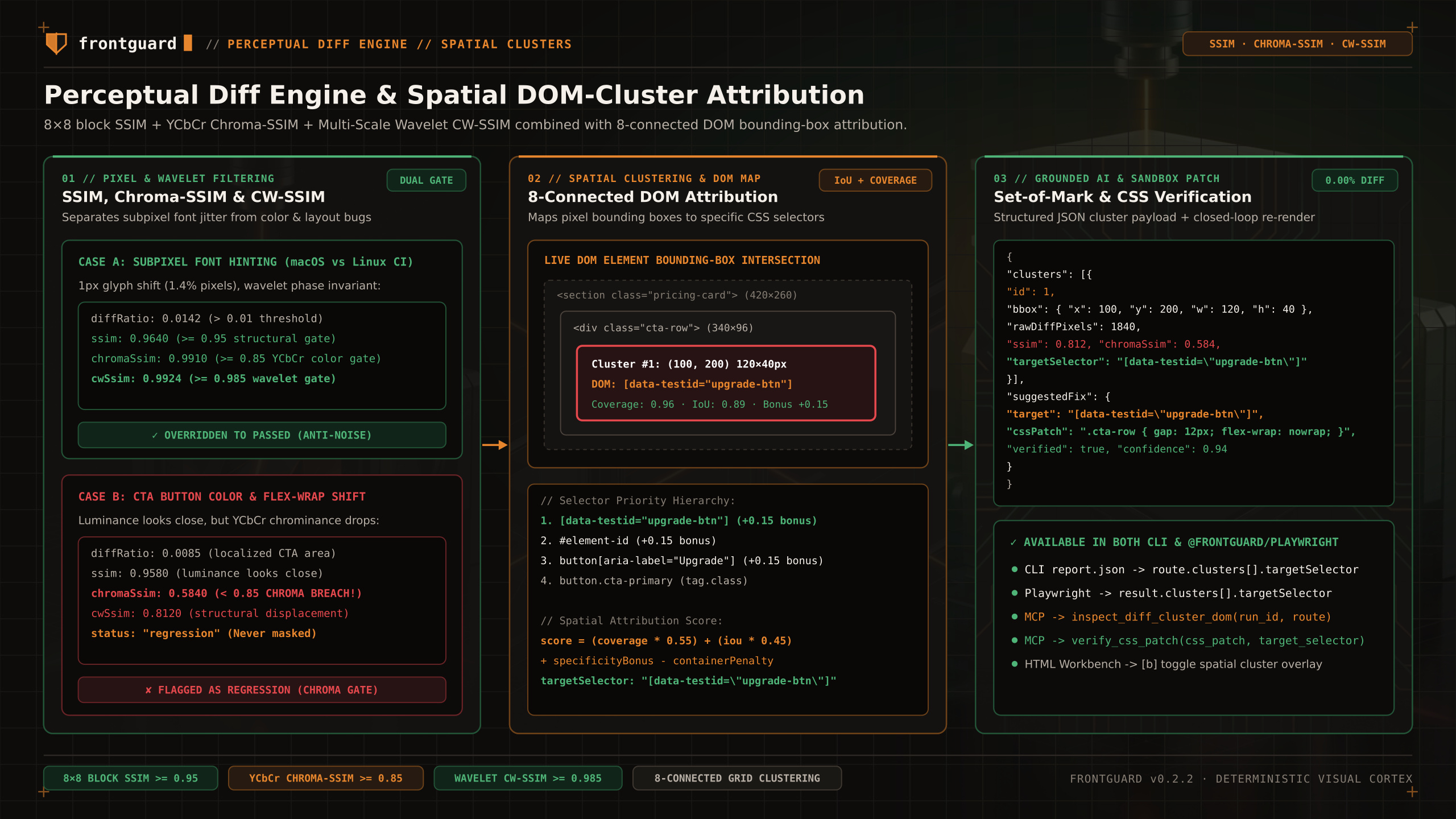
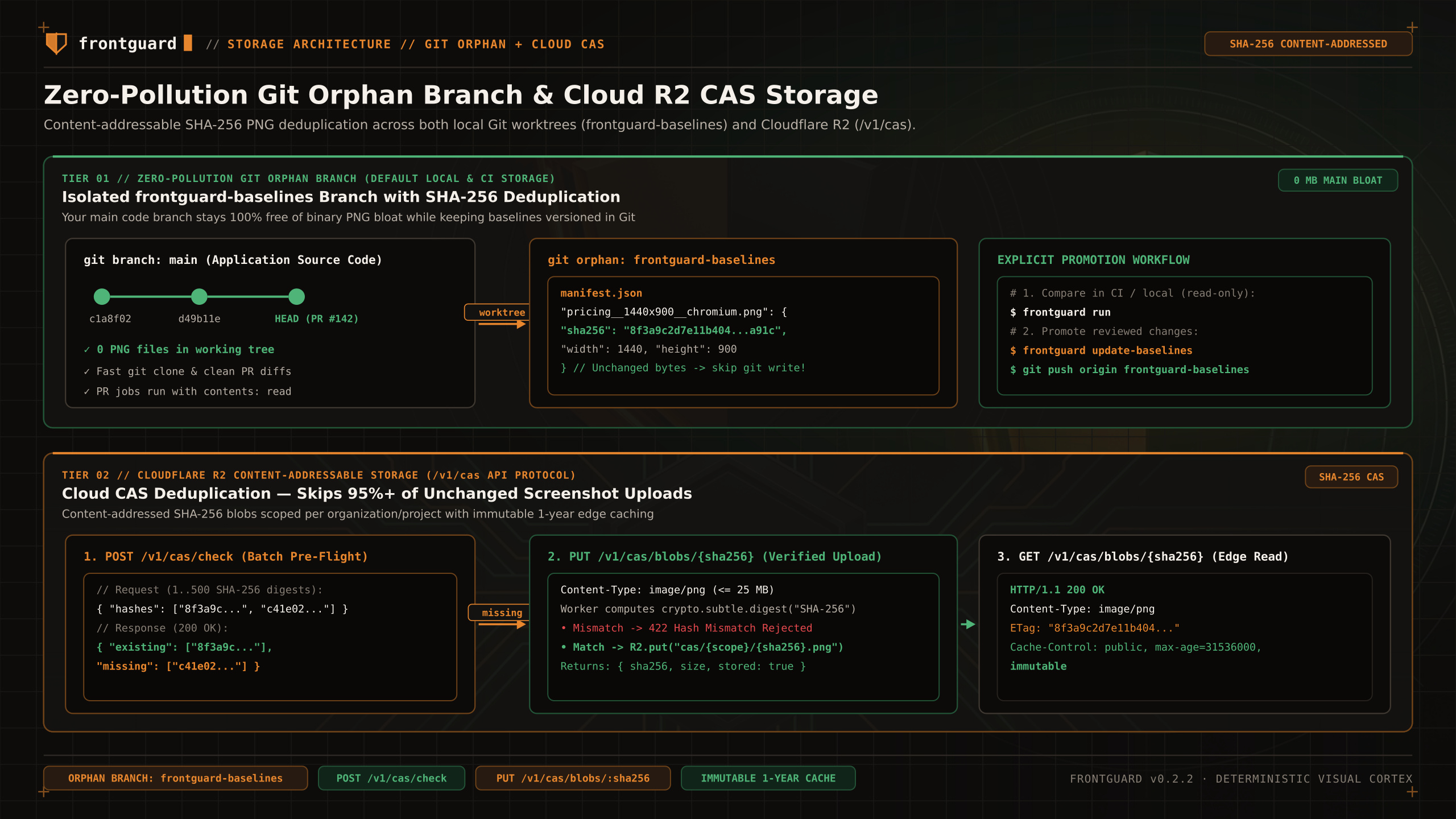
How local-first perceptual diffing and zero-bloat storage work.
FIG 01 // Pixelmatch + Chroma-SSIM + Wavelet CW-SSIM with 8-connected DOM cluster attributionFIG 02 // Isolated frontguard-baselines git orphan branch and SHA-256 content-addressable storage
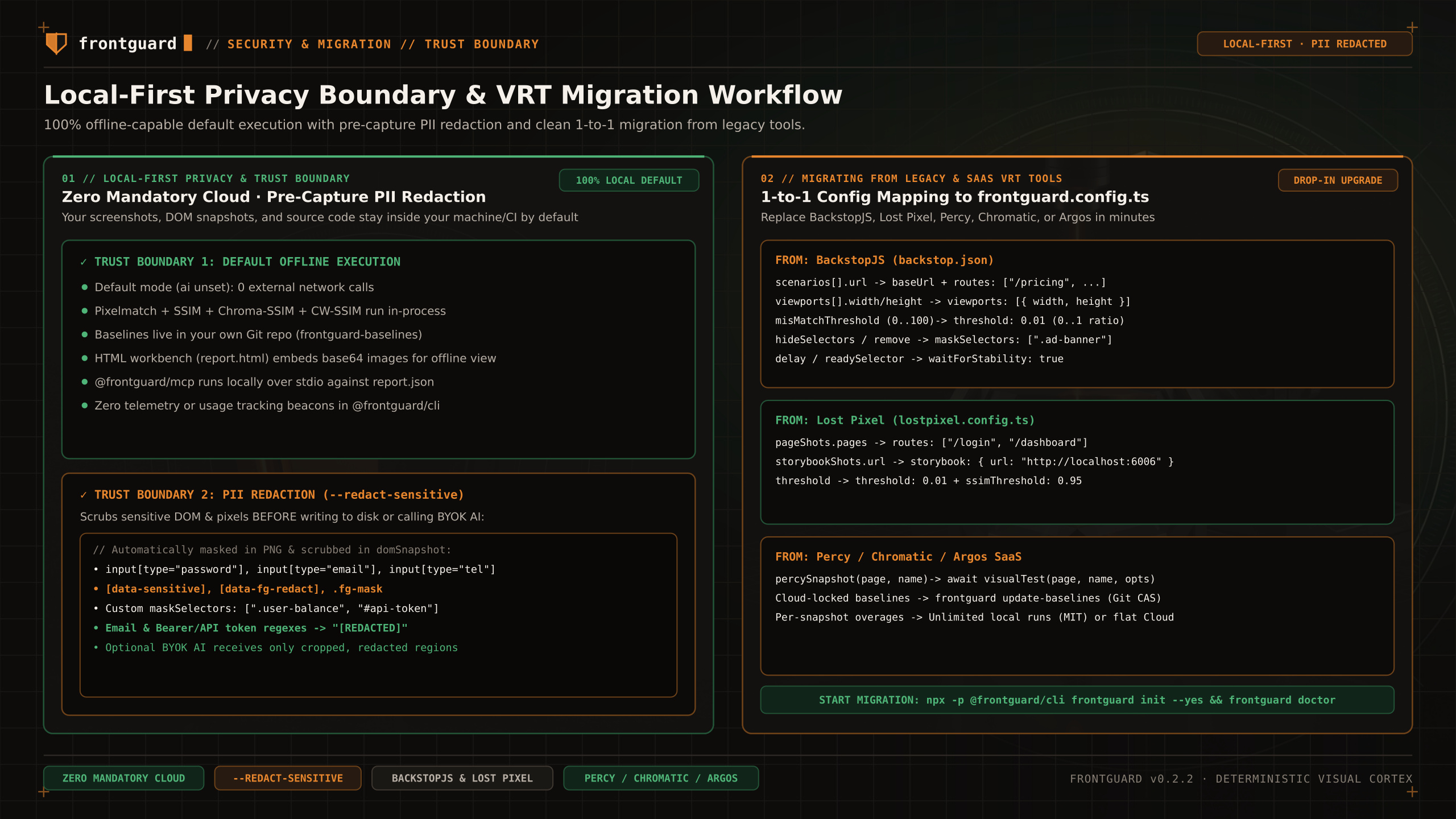
Switching is a config file, not a rewrite.
Frontguard reads your app by URL, with no test files to port and no proprietary snapshot format. Point it at your dev server, review the captures, then accept them with one baseline-update command. Migration guides walk through the rest.